In the jewelry boxes of the Late Victorian Era, there lies a very special type of necklace.
At first glance, they seem to be just ordinary clear crystal beads. But when you pick one up and look at the world through the bead, you will find that all scenes are inverted—just like looking at a flower through a morning dewdrop.
These are the famous “Pools of Light”.
🔮 What are Pools of Light?
True Pools of Light must meet two strict conditions:
- Material must be Natural Rock Crystal: Not glass, nor lead crystal.
- Absolutely Undrilled: This is its core characteristic.
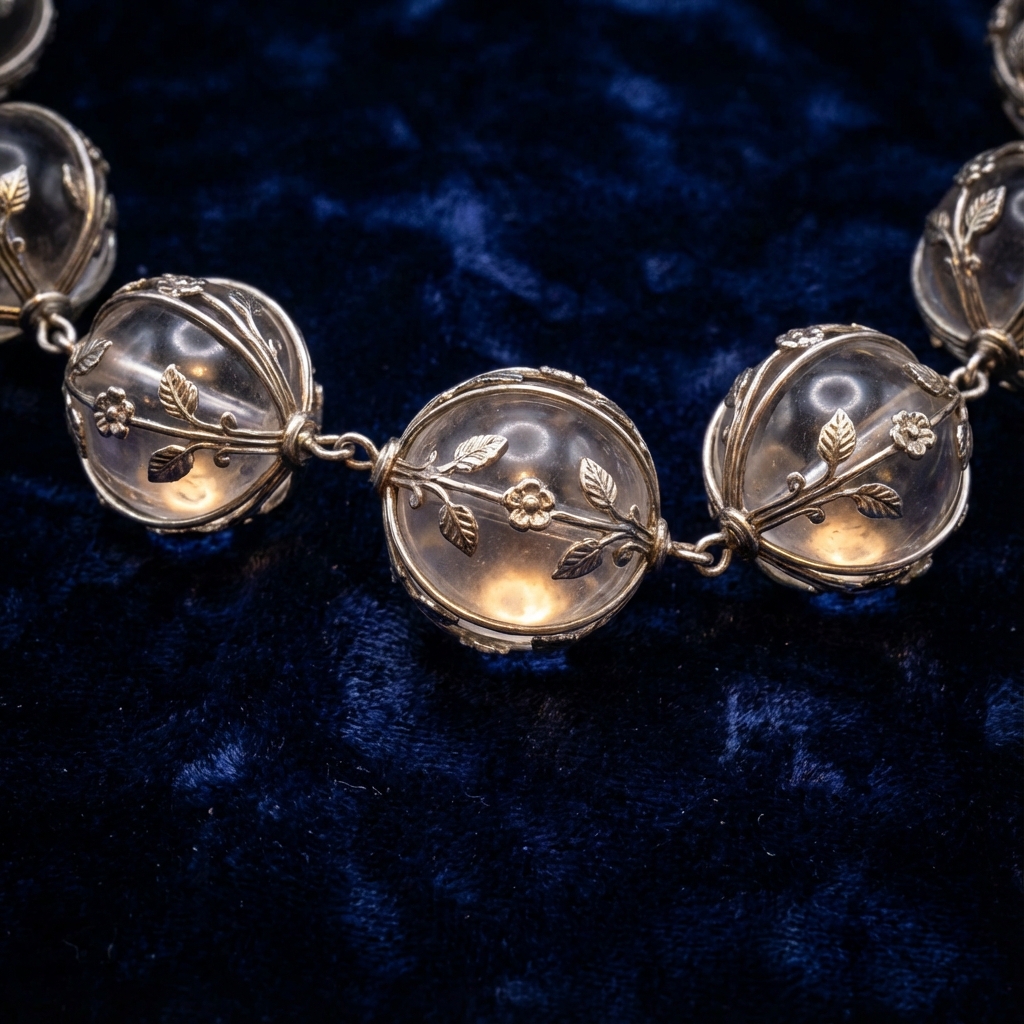
Ordinary beads are drilled in the center for stringing. But every crystal sphere of Pools of Light is wrapped from the outside by silver or gold wire, like a “birdcage”.
Why Not Drill?
This stems from a fascinating Chinese legend (yes, this style was deeply influenced by the 19th-century “Chinoiserie”).
Ancients believed that natural crystals contained energy (“Chi”) and good luck inside. If the crystal is drilled, this good luck will flow away like water, and the energy will dissipate.
Therefore, to keep this “luck”, Victorian craftsmen invented this unique setting technique: wrapping metal wire around the surface of the crystal sphere, which not only fixed the bead but also preserved its integrity.
💡 Identification: Crystal vs. Glass
In the antique market, it is common to find glass spheres passing off as Pools of Light. Master these three points, and you can spot the difference at a glance:
1. The Image Test
This is the most intuitive method.
- Pools of Light (Rock Crystal): Due to the high refractive index of crystal, when you look at an object through it, the image you see is inverted.
- Glass: Although you can also see an image, it is usually not as sharp as crystal, and the refraction effect is different.
2. Double Refraction
This is the physical smoking gun.
- Find a piece of paper with text (like a newspaper).
- Place the crystal sphere over the text and rotate it gently.
- Natural Crystal: You will see the text below turn into a double image (ghosting). This is because light splits into two beams when passing through the crystal.
- Glass: No matter how you turn it, the text remains single; there is no ghosting.
3. The Temperature Test
- Natural Crystal: Conducts heat fast, feels ice cold to the touch, and this coolness lasts for a relatively long time.
- Glass: Feels relatively mild and warms up quickly with body heat.
📚 References
- Sibylle Jargstorf, Baubles, Buttons and Beads: The Heritage of Bohemia (Schiffer Publishing, 1993).
- GIA (Gemological Institute of America), “Rock Crystal Quartz: History and Lore”.
- Victoria & Albert Museum, “Jewellery Collection”.
💎 Collection Value
A well-preserved Victorian Pools of Light necklace often commands a high price in the antique market today (usually $1000 - $3000 USD or even higher, depending on the size of the spheres and the metal material).
They are expensive not only because large, flawless natural rock crystals are rare, but also because of that “do not destroy, only protect” setting craftsmanship, representing the era’s ultimate respect for natural objects.
Wearing Experience: Wearing a Pools of Light necklace is like hanging dozens of miniature crystal balls around your neck. Under candlelight or sunlight, every bead gathers light, truly like little glowing pools illuminating your face.
If you encounter an undrilled, ice-cold, double-refracting crystal necklace in an antique shop, do not hesitate. What you meet is not just jewelry, but a string of good luck sealed for a century.