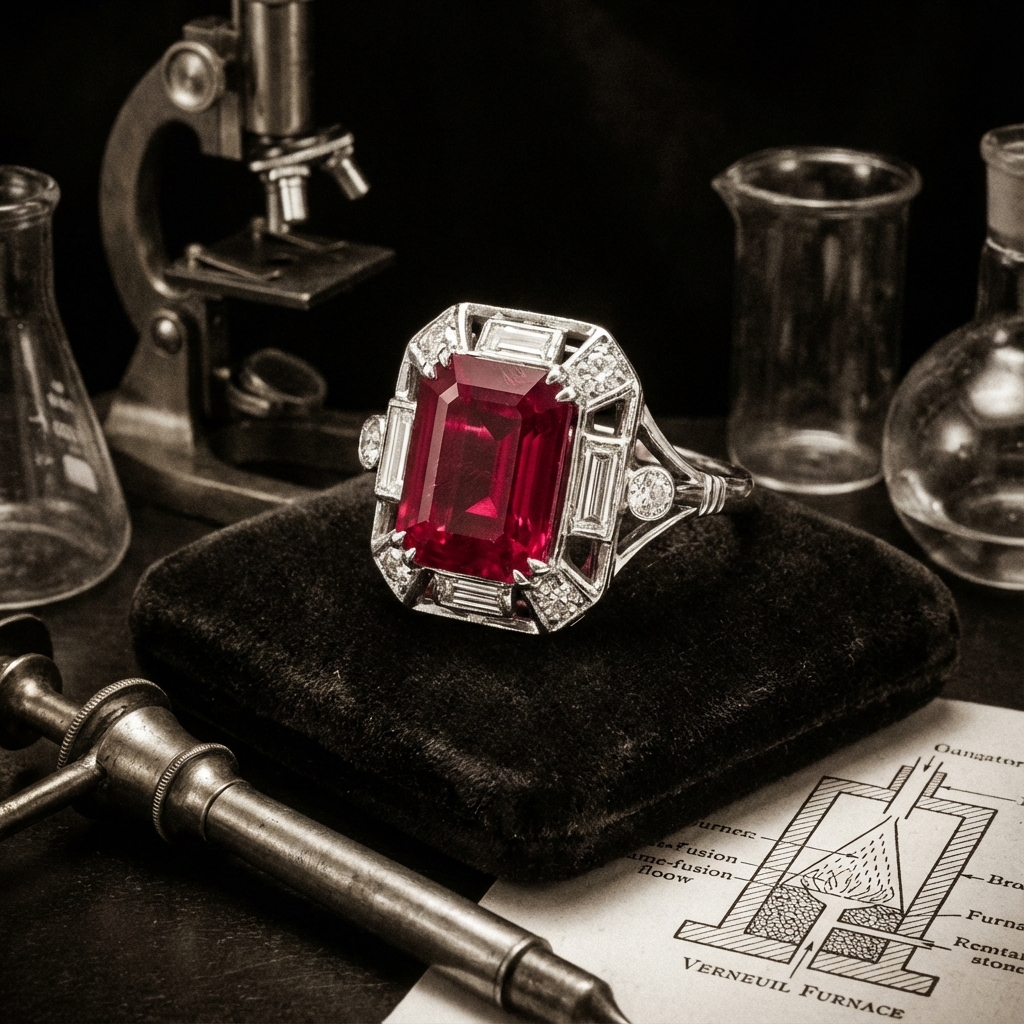
If you bought an Art Deco ring from the 1920s, and the main stone is a ruby or sapphire with perfect color, high clarity, and almost no inclusions, don’t be too happy just yet.
Because there is a 90% chance it is Synthetic.
Today, “synthetic” often implies cheapness. But 100 years ago, this was “black technology” representing humanity’s conquest of nature.
🔬 The Verneuil Process
In 1902, French chemist Auguste Verneuil announced to the world that he had successfully created rubies in the laboratory.
This method is called “Flame Fusion”. Simply put, aluminum oxide powder is melted by a high-temperature flame and then crystallized drop by drop into a carrot-shaped crystal (Boule), just like dripping candle wax.
Why Was It So Popular in Art Deco?
- Color Revolution: Art Deco pursued strong geometric contrasts and vivid colors. Natural rubies and sapphires often have secondary hues or cracks, making it difficult to achieve the “perfect red” or “perfect blue” required by designers. Synthetic gemstones could do it.
- Worship of Science: The early 20th century was an era of scientific explosion. Wearing a gemstone created by scientists in a laboratory was an Avant-garde fashion attitude at the time, just like wearing an Apple Watch today.
🕵️♀️ Identification: Curved Growth Lines
Although synthetic rubies and natural rubies have exactly the same chemical composition (both are corundum), their growth environments are different, leaving different traces.
Pick up your 10x loupe and observe the inside of the gem:
- Natural Ruby: You will see Straight Growth Lines or hexagonal color bands.
- Verneuil Synthetic Ruby: You will see Curved Striae. This is because the crystal cooled gradually while rotating, creating arc lines like a vinyl record. In addition, you may also see tiny Gas Bubbles, which are absolutely absent in natural gemstones.
💡 Collection Value
So, are synthetic gemstones in antiques worth buying?
The answer is yes, but it depends on the setting.
If this synthetic ruby is set in an exquisitely crafted Art Deco platinum diamond ring, then its value mainly comes from the craftsmanship of the mount and the historical value of the era, not the main stone itself.
In fact, many top jewelers (even including Cartier and Tiffany) used synthetic gemstones during that period.
📚 References
- Kurt Nassau, Gemstone Enhancement: History, Science and State of the Art (Butterworth-Heinemann, 1994).
- The Gemmological Association of Great Britain (Gem-A), “Gem Knowledge Hub”.
- Lang Antiques University, “Synthetic Gemstones”.