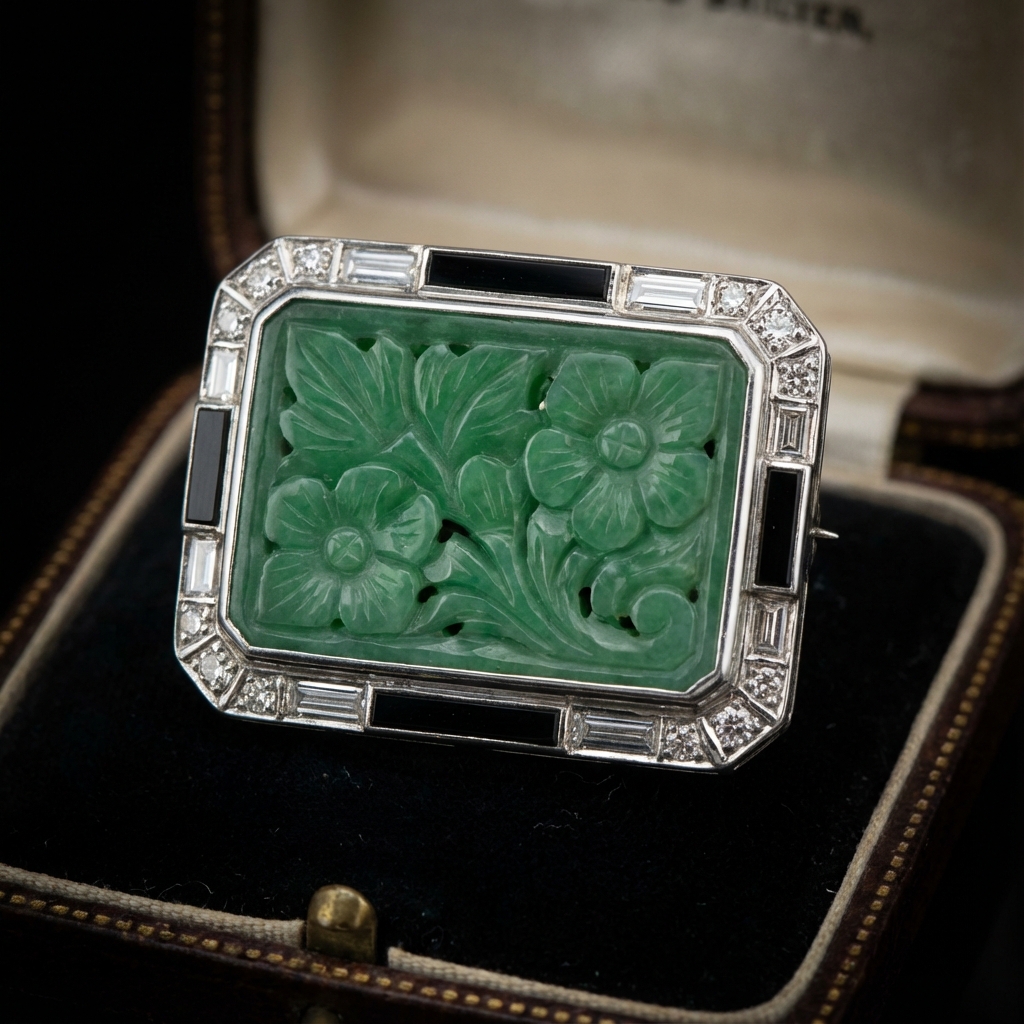
If you see an Art Deco brooch by Cartier or Van Cleef & Arpels at a Sotheby’s or Christie’s auction, featuring an exquisitely carved piece of jade in the center, do not be surprised.
This is not a modern fusion of East and West, but the craziest fashion of the European upper class 100 years ago—“Chinoiserie”.
🌏 Jade’s Journey to the West
Before the late 19th century, Westerners knew almost nothing about Jadeite. They were more familiar with Nephrite.
It was not until around 1900, as treasures from the Qing imperial court flowed overseas, that this “hard jade” with intense color and translucent texture completely conquered Parisian jewelers.
For Cartier at that time, jade was not just a gemstone, but a ready-made work of art.
🎨 Design Aesthetic: Collision of Geometry and Carving
Art Deco emphasized geometric lines, black-and-white contrast, and mechanical beauty. Chinese jade carving, on the other hand, was full of curves, symbolism, and naturalism.
These two distinct styles sparked amazing chemistry in the 1920s:
- Extreme Contrast of Black and Green: Designers loved to use Onyx or Black Enamel to set off the emerald green of the jade. This strong color contrast is the signature language of Art Deco.
- Touch of Red: To break the cool tones, they often accented with a few Rubies or Coral. This actually borrowed from the traditional Chinese color scheme of “red and green,” but under the harmonization of platinum and diamonds, it looked exceptionally sophisticated.
- New Use for Old Objects:
- Belt Hook: Qing Dynasty dragon-head belt hooks were transformed into brooches or handles for letter openers.
- Carved Plaque: Jade plaques originally meant to be sewn onto clothing were set in the center of Vanity Cases or made into pendants.
💎 Old Mine Jade vs. Modern Jade
When collecting this type of jewelry, you will find that the jade on it is quite different from the “Glassy Species” or “Imperial Green” pursued in the modern market.
- Texture: The jade from that time was mostly “Old Mine”. Although it may not have the high transparency (water quality) pursued today, it has a strong “gelatinous look” (colloidal texture), with calm, rich colors and a warm, greasy luster.
- Carving: The carving is usually the work of Qing Dynasty craftsmen, with fluid lines but not as regular as modern machine carving. This “handmade feel” is precisely an important basis for dating.
💡 Collection Advice
Owning a piece of Art Deco jade jewelry means possessing the art of two eras simultaneously: Qing Dynasty carving craftsmanship + Early 20th-century setting design.
Although signed pieces by Cartier are now sky-high in price, we can still find many unsigned but exquisitely crafted similar works in the antique market.
📚 References
- Hans Nadelhoffer, Cartier: Jewelers Extraordinary (Harry N. Abrams, 1984).
- Sotheby’s, “Cartier”.
- L’École, School of Jewelry Arts, “L’École, School of Jewelry Arts”.