In the world of antique silver, French pieces are revered for their extremely high purity of 950/1000 (higher than British Sterling 925). However, their complex hallmark system often intimidates collectors.
In reality, French marks evolved through four distinct historical periods, reflecting the changing regimes. Based on authoritative charts, we classify them as: The Chaos, The Rooster Period, The Old Man Period, and The Minerva Period.

🌪 Phase 0: The Chaos (L’Association)

Period: 1793 - 1798
This is a historically fascinating “vacuum” period. In 1791, the Fermes Générales (Silversmith Corporation) was abolished. Although the ancient duty collector Jean-Francois Kalandrin was asked to resume control, the newly liberated silver-workers were disorganized and refused to present their works to the assay office. Kalandrin eventually abandoned the task.
- Result: Silver from this period bears unofficial marks known as the “Association des Orfevres” marks, or sometimes no marks at all. This chaos lasted until the government strictly imposed the Rooster system in 1798.
🐓 Phase 1: The Rooster (Le Coq)
Period: 1798 - 1819
Following the French Revolution, the old guild system was abolished, and a state-controlled guarantee system was established. The symbol chosen was the “Gallic Rooster”.
1. 1st Rooster (1er Coq, 1798-1809)

The earliest modern French hallmark.
- 1st Standard (950): Rooster facing RIGHT, inside an Octagonal frame, with the number 1.
- 2nd Standard (800): Rooster facing LEFT, frame varies.
2. 2nd Rooster (2me Coq, 1809-1819)

Late Napoleonic era.
- Feature: The Rooster remains, but the frame is heavier, typically a double-lined oval. The rooster rests on the number 1 or 2.
- Style Note: Silver from this period often exhibits the bold “Empire Style”, featuring sphinxes, palm leaves, and rigid symmetry.
👴 Phase 2: The Old Man (Vieillard / Michel-Ange)

Period: 1819 - 1838
After the Bourbon Restoration, the revolutionary Rooster was abolished. It was replaced by the head of a bearded classical figure, known as Le Vieillard (The Old Man) or Michel-Ange (Michelangelo).
- 1st Standard (950): Old Man facing RIGHT, with the number 1 inside the frame.
- 2nd Standard (800): Old Man facing RIGHT, with the number 2 inside the frame.
🔍 Paris vs. Provinces: During this period, marks from Paris typically included Greek letters, while provincial marks used Arabic numerals or specific symbols.
🏛 Phase 3: The Goddess Minerva (Minerve)
Period: 1838 - Present
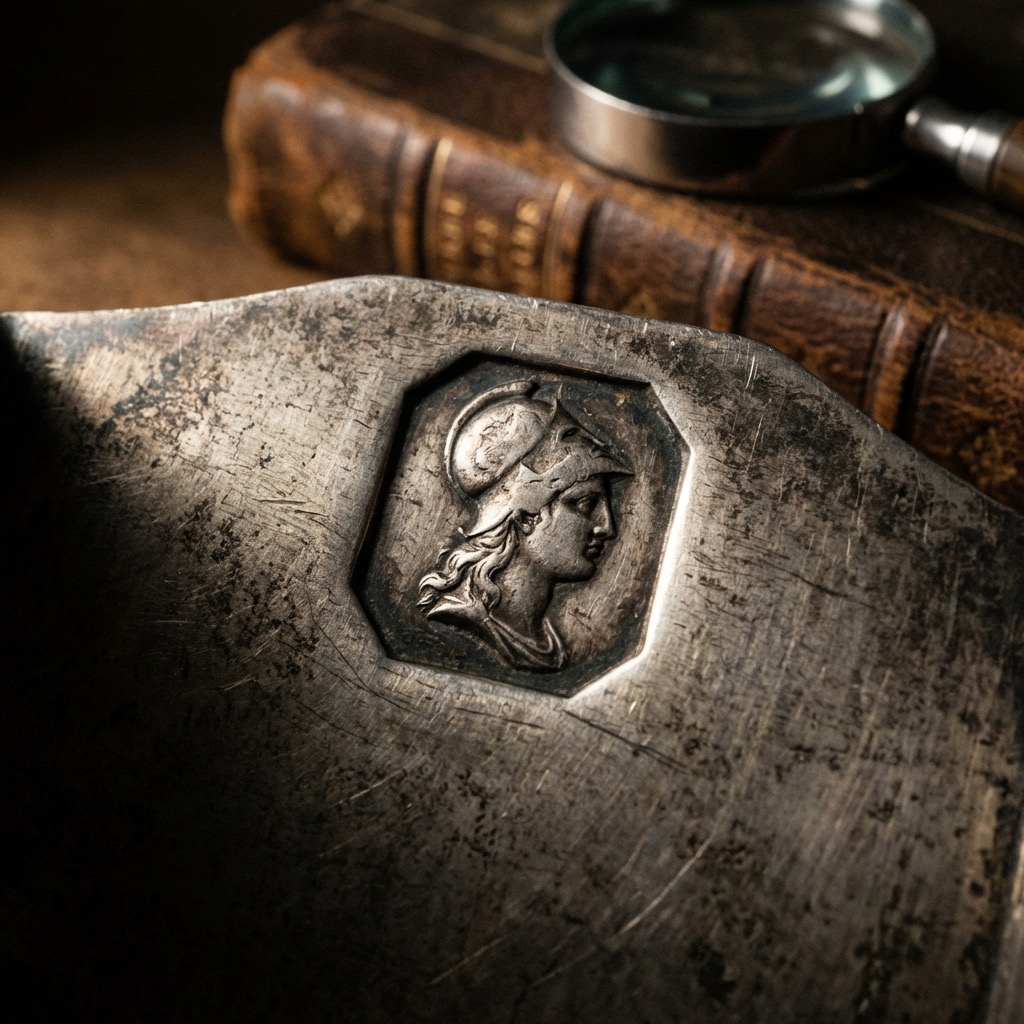
This is the most common and enduring system. If your French silver was made after 1838, focus here.
1. Large Guarantee (Grosse Garantie)
For large items (teapots, plates, flatware).
- 1st Standard (950‰): Minerva profile facing RIGHT.
- Frame: Octagonal. This is the key. Remember: “Octagon = 950”.
- 2nd Standard (800‰): Minerva profile facing RIGHT.
- Frame: Barrel / Rounded Rectangle.
2. Small Guarantee (Petite Garantie)
For tiny items (thimbles, jewelry) where the complex Minerva head would blur, animals were used instead.
- 🐗 Boar’s Head (Tête de Sanglier): Indicates Paris manufacture (800+ purity).
- 🦀 Crab (Crabe): Indicates Provincial manufacture (800+ purity).
- Note: After 1962, the Crab replaced the Boar as the universal small guarantee mark.
3. Export Mark (Mercure)
If you see a profile with a winged helmet, that is Mercury.
- Used exclusively for items intended for export (as other countries required different purity verifications).
♦️ The Golden Rule: The Maker’s Mark
Regardless of the period (Rooster, Old Man, or Minerva), one rule in French silver never changed:
The Maker’s Mark MUST be a Lozenge (Diamond Shape)!
- Lozenge (♦️) = Solid Silver.
- Square (⏹) = Silver Plate.
⚠️ Practical Tip: When you see brands like Christofle or Ercuis, check the frame carefully. If it’s a square containing scales, it’s silver plate. Only a Lozenge frame signifies solid silver.
📝 Summary Table
| Period | Symbol | Purity Key | Frame Characteristic |
|---|---|---|---|
| 1798-1809 | Rooster (1st Coq) | Numeral 1 / 2 | Octagon = 950 |
| 1809-1819 | Rooster (2nd Coq) | Numeral below | Double oval frame |
| 1819-1838 | Old Man (Vieillard) | Numeral right | Classical bearded head |
| 1838-Now | Minerva | Frame Shape | Octagon = 950 |
| (Small) | Boar / Crab | - | Boar for Paris, Crab for Provinces |